
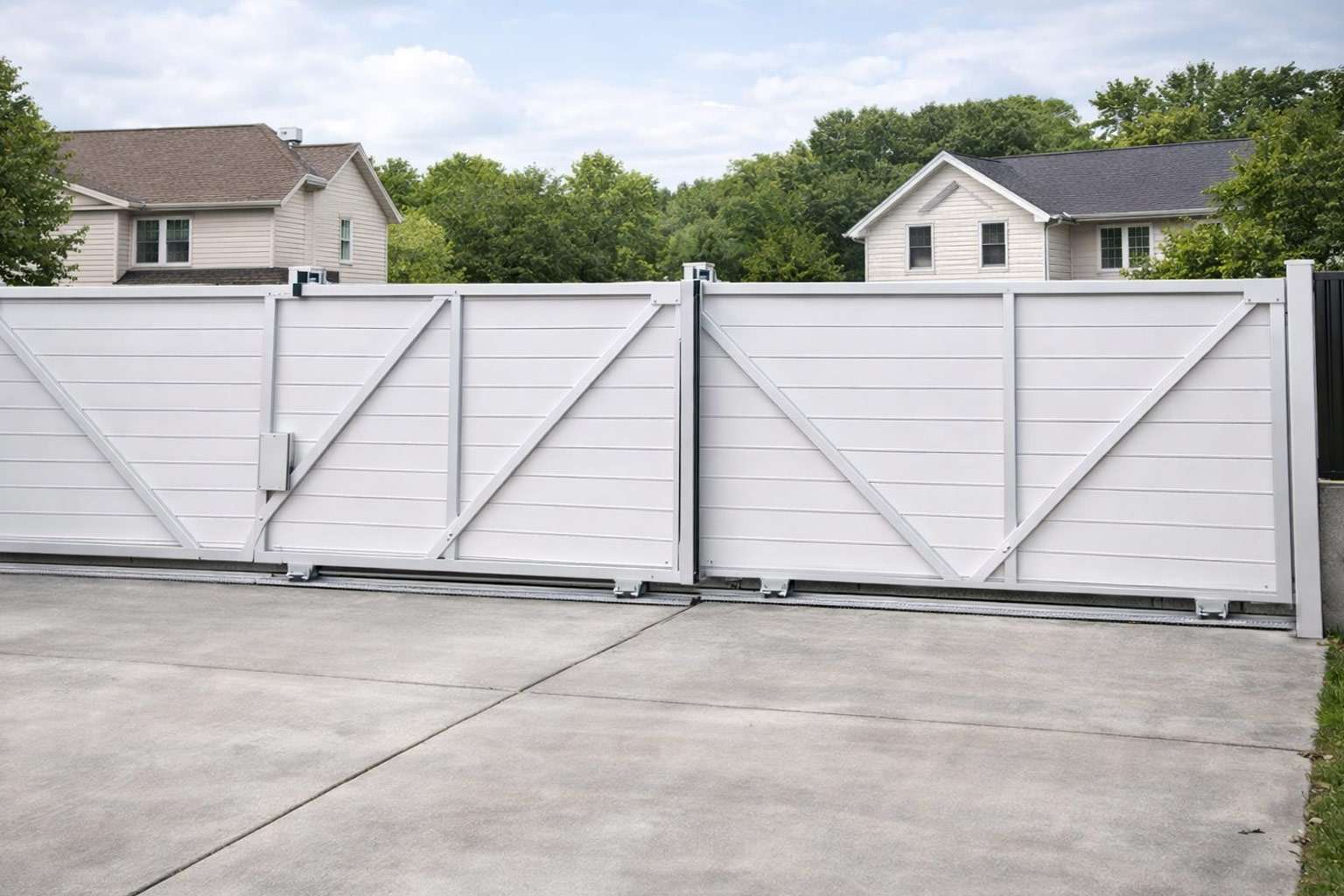
What is a gate loop detector, and why does it stop working? A gate loop detector is the small electronic unit at your gate operator that watches a coil of wire buried in the pavement and tells the gate when a vehicle is over it, so the gate can open for exiting traffic or stay open until a vehicle has cleared. Most loop failures are not caused by the detector itself. They start in the pavement, where cracked concrete or asphalt, failed loop sealant, and water damage the loop wire and cause a gate that will not open, will not close, or acts on its own.
78 Fence installs and repairs direct burial, saw-cut, and pave-over vehicle detection loops for commercial gates across Dallas-Fort Worth. This guide explains how loop detectors work, what each loop does, and why they fail.
How Does a Vehicle Loop Detector Work?
A loop system has three parts: the loop, the lead-in wire, and the detector.
- The loop: several turns of insulated wire laid in a rectangle or diamond shape, either cut into existing pavement or buried under new concrete or asphalt
- The lead-in: a twisted pair of wires that runs from the loop back to the gate operator
- The detector: a module, often plugged into the operator’s control board, that powers the loop and reads it
The detector sends a small alternating current through the loop, creating a magnetic field above the pavement, and tunes itself to the empty loop as a baseline. When a vehicle pulls over the loop, its metal changes the loop’s inductance and shifts the frequency the detector watches. If the change passes the sensitivity setting, the detector signals the operator to open, hold, or reverse.
A loop does not weigh the vehicle or need to be touched. It responds to metal, which is why a parked car keeps a gate held open and a person walking across a loop usually does nothing.
How high can a loop detect a vehicle?
Detection height depends mostly on the short side of the loop. DoorKing’s loop guide puts detection height at roughly one half to two thirds of the length of the short leg, so a 4 foot by 8 foot loop detects about 2 and a half feet up. Trucks and trailers with high frames can be missed by a loop that is too small. We typically size loops 4 to 6 feet narrower than the roadway, so a 12 foot drive gets an 8 foot wide loop.
What Do the Different Loops at a Gate Do?
Most automated commercial gates use more than one loop, and each sends a different message to the operator.
- Exit loop: placed on the secure side, several feet back from the gate. When a vehicle drives over it, the gate opens automatically, so drivers can leave without a code, card, or remote. This is often called free exit.
- Safety or reversing loops: placed close to the gate on one or both sides. If a vehicle is over one of these loops while the gate is closing, the gate stops or reverses, and while the vehicle is there the gate will not start to close.
- Shadow loop: used mainly on swing gates, placed in the area the gate swings through. It keeps a fully open or fully closed gate from moving while a vehicle sits in its path.
- Center or arming loop: often placed at a keypad, card reader, or barrier arm so the access device only responds when a vehicle is actually present, or so the operator knows when a vehicle has passed through.
Not every site needs all four. A busy truck entrance may use several loops working together with the access control system on your commercial gate.
Are Loop Detectors Safety Devices?
They protect vehicles, not people. Loops are very good at keeping a gate from closing on a car or truck, but a loop cannot reliably sense a person, a child, or a pet, so it does not count as entrapment protection.
Under UL 325, an automated gate needs monitored entrapment protection, such as photo eyes or edge sensors, that the operator checks before it will run. DASMA, the trade association for gate and door operator manufacturers, describes vehicle loop detectors as ancillary vehicle protection that can be added to a system but can never take the place of the primary monitored entrapment device. A well designed commercial gate uses both: loops for vehicles, and photo eyes and edges for people. Read more about automatic gate safety and UL 325.
Why Do Gate Loop Detectors Fail?
When an automated gate starts acting strangely, the loop system is one of the first places to look. Most problems trace back to the loop wire and the pavement around it, not the detector module.
Cracked pavement and failed sealant
A saw-cut loop sits in a narrow slot sealed with loop sealant. As pavement cracks, settles, or moves with heat and traffic, the sealant pulls loose and the wire can stretch, chafe, or break. North Texas clay soil makes this worse, because it swells when wet and shrinks when dry, which keeps drive surfaces moving.
Water reaching damaged insulation
Once a cut opens or the insulation is nicked, moisture gets in. A damaged loop may work on a dry afternoon and fail after rain, sprinklers, or morning dew, because water creates a path to ground. That is why many loop problems come and go with the weather.
Poor splices and lead-in problems
Unsealed splices, connections buried in the ground, or a loosely twisted lead-in can cause false calls or a loop that locks on. EMX, a loop detector manufacturer, calls for the lead-in to be twisted at least six turns per foot to reject electrical noise.
Crosstalk between nearby loops
Loops close together, such as entry and exit loops, can interfere when their detectors run on similar frequencies. Most detectors have a frequency setting to separate them.
Wrong sensitivity, wrong size, or wrong placement
A detector set too high can react to the next lane or the moving gate. One set too low can miss motorcycles or high clearance trucks. Loops that are too small or too close to the gate cause similar problems, and in concrete the loop should sit above the rebar.
Detector, power, and operator issues
Detectors do fail, especially after lightning or power surges, but less often than loops in the ground. A loose detector, weak power supply, or faulty operator input can also look like a loop problem.
Gate Loop Problems: Symptoms, Likely Causes, and Fixes
These are the patterns we see most often on commercial gates and where we start troubleshooting.
| Symptom | Likely cause | Typical fix |
|---|---|---|
| Gate stays open and will not close | Safety loop shorted or broken, detector stuck on a call, or a loop set to fail safe and holding the gate open | Test the loop, check detector diagnostics, repair or replace the damaged loop |
| Gate opens with no vehicle present | Exit loop sensitivity too high, crosstalk from a nearby loop, water in the loop, or a loose splice | Adjust sensitivity or frequency, reseal or rebuild splices, replace a wet loop |
| Gate will not open for exiting vehicles | Broken exit loop wire, disconnected lead-in, sensitivity too low, or a failed detector | Check continuity, reconnect or replace wiring, retune or replace the detector |
| Problems only after rain or sprinklers | Nicked insulation shorting to ground, open saw cuts letting water in | Insulation resistance test, then reseal or replace the loop |
| Gate starts closing while a truck or trailer is still in the opening | Loop too small for high vehicles, wrong placement, or low sensitivity | Resize or relocate the loop, adjust detector settings |
How Do Technicians Test a Gate Loop?
A good diagnosis isolates each part before anything gets replaced:
- Visual inspection: checking saw cuts, sealant, and pavement over the loop for cracks and gaps
- Detector diagnostics: reading indicator lights and the sensitivity, frequency, and fail mode settings
- Continuity: confirming the loop wire is one unbroken circuit
- Insulation resistance to ground: using a megohm meter to find damaged insulation that a regular meter will not catch. DoorKing’s guidance treats a reading above 100 megohms as good and below 50 megohms as a loop that needs to be replaced.
- Function test: driving over each loop to confirm the gate responds correctly, and testing the photo eyes and edges
If the detector checks out and the loop wire is damaged, the fix is usually a new loop rather than another detector.
Can a Broken Gate Loop Be Repaired?
Sometimes. A bad splice, loose connection, or wiring problem at the operator can often be repaired without touching the pavement. If the loop wire itself is broken or its insulation is damaged, the reliable fix is a new loop.
On existing concrete or asphalt, that usually means a new saw-cut loop. We cut a 3/16 inch slot, lay the loop wire, and seal it with loop sealant. On new concrete pours, gravel, or dirt drives, a direct burial loop can be placed before the surface goes in, and on asphalt that is being resurfaced, a pave-over loop can go down with fresh asphalt over it. We source our direct burial and saw-cut loops from BD Loops, and we can install them in freezing weather using quick cure or winter blend sealant.
If the pavement around the old loop is badly broken, plan the new loop in sound pavement or together with concrete or asphalt repair, so the same cracks do not damage it.
What Are the Alternatives to Loop Detectors?
Installed correctly, loops are one of the most reliable ways to detect vehicles, but other sensors fill specific roles:
- Photo eyes: required for entrapment protection and can add vehicle protection at vehicle height, but they sense a line, not a zone
- Microwave or radar sensors: mounted above ground, useful where pavement cannot be cut
- Magnetic probes: buried beside the drive, often used for free exit on gravel or pavers
How Can You Keep Gate Loops Working Longer?
Start with a correct installation: the right loop size, sealed splices, and placement for your gate. After that, inspect the saw cuts and sealant during routine gate maintenance, repair cracked pavement around loops early, keep trailers and dumpsters off the loops, and schedule loop work with any paving project so loops are not cut or covered by accident. A loop that fails now and then usually gets worse, so call at the first sign of trouble.
If your gate holds open, opens on its own, or ignores vehicles, our team provides commercial gate repair in Dallas, including operator troubleshooting and safety loops. We also repair vehicle detection loops for properties needing commercial gate repair in Irving and commercial gate repair in Arlington. Planning a new high-traffic entrance? Our guide to bi-folding speed gates for commercial facilities shows how loops work with a fast gate.
Frequently Asked Questions About Gate Loop Detectors
How does a gate loop detector work?
A gate loop detector powers a coil of wire buried in the pavement and watches its inductance. When a vehicle’s metal passes over the loop, the inductance and frequency change, and the detector sends a signal to the gate operator to open, hold, or reverse the gate. It senses metal, not weight, so it does not need to be touched.
Why won’t my automatic gate close?
A damaged or shorted safety loop is one of the most common reasons. When a loop or detector reports a vehicle that is not there, the operator holds the gate open, and many detectors are set to hold the gate open when they sense a fault. Photo eyes that are blocked or out of alignment can cause the same symptom.
Why does my gate loop only fail when it rains?
Wet weather failures usually mean water is reaching damaged loop wire insulation through cracked pavement or failed sealant. The moisture creates a path to ground that confuses the detector, then the loop seems to work again once it dries out. An insulation resistance test can confirm it, and the usual fix is resealing or replacing the loop.
How long do gate loops last?
A properly installed and sealed loop in sound pavement can last many years, since the wire has no moving parts. Lifespan depends mostly on the pavement: loops in cracking or shifting concrete and asphalt can fail much sooner. Regular inspection of the saw cuts and sealant helps loops last longer.
Can a loop detector sense a person or motorcycle?
A loop is not designed to detect people and should never be relied on for pedestrian safety. That is the job of monitored photo eyes and edge sensors required under UL 325. Motorcycles and small vehicles can be detected, but only when the loop is sized and the detector sensitivity is set correctly.
Does 78 Fence repair gate loops in Dallas-Fort Worth?
Yes. 78 Fence repairs vehicle detection loops, safety sensors, and gate operators on commercial gates across Dallas-Fort Worth. We also install direct burial, saw-cut, and pave-over loops, with direct burial and saw-cut loops sourced from BD Loops.
Gate Loop Detector Repair and Installation in Dallas-Fort Worth
Since 1978, 78 Fence has built fences and gates for Dallas-Fort Worth businesses, with gate automation experience going back to 1989. Owner Robert O’Neal is a Certified Automated Gate Operator Installer through IDEA, training built around UL 325 and ASTM F 2200. We find the real cause, repair what can be repaired, and recommend new loops only when they are needed. See all of our automated security gates.
Gate acting up? Call 78 Fence at 214-351-0212, email robert@78fence.com, or contact us online to schedule gate loop repair or installation for your commercial property.