
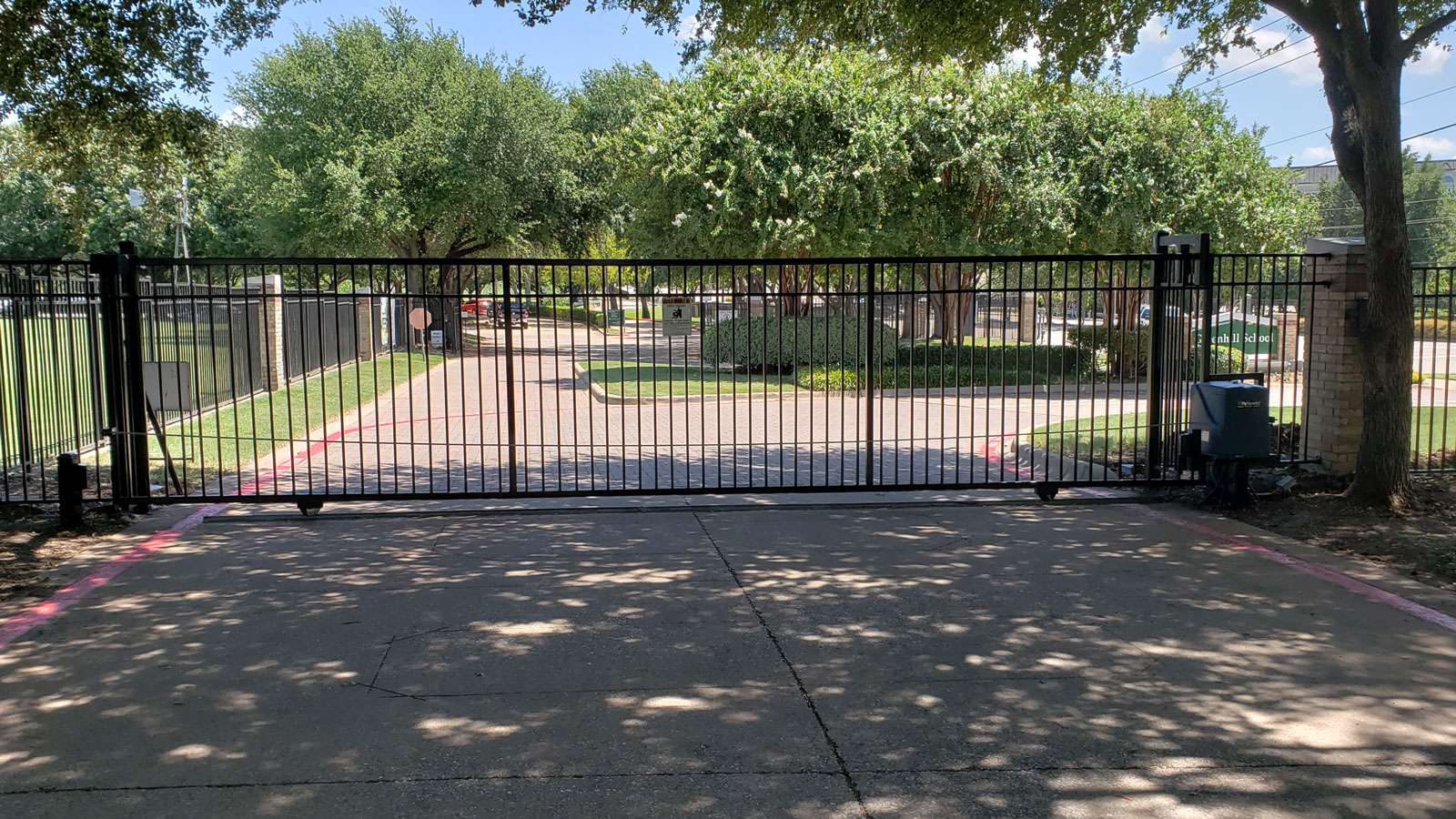
What do apartment and HOA gates in Dallas need to work well? A gated community entrance needs three things: a gate and operator sized for the number of cycles it runs every day, an access control system that lets residents in quickly while screening visitors, and a regular maintenance plan that keeps safety devices working. When any one of those is missing, the gate ends up stuck open, stuck closed, or breaking down over and over.
Community entrances work harder than almost any other gate in Dallas-Fort Worth. An apartment complex or HOA gate can open and close hundreds of times a day for residents, guests, delivery drivers, trash trucks, and emergency vehicles. This guide covers the gate types that fit community entrances, how to choose access control for residents and visitors, the safety features every automatic gate needs, and how to keep the system reliable year after year.
Why Do Gated Communities and Apartment Complexes Use Entry Gates?
Property managers and HOA boards install entry gates to control who comes onto the property, protect residents and their vehicles, and give the community a clear, professional entrance. A well-planned gate system can:
- Limit through traffic and discourage people who have no reason to be on the property
- Give residents fast, credential-based entry while visitors are screened at a call box
- Create a record of who entered and when, depending on the access control system
- Separate vehicle and pedestrian traffic with dedicated pedestrian gates for gated communities and HOAs
- Pair with perimeter fencing so the gate is not the only line of protection
At 78 Fence, multi-family communities, apartment complexes, and HOAs are part of the commercial work we do every week, alongside warehouses, office parks, and municipal sites.
Which Gate Types Work Best for Apartment and HOA Entrances?
The right gate depends on the width of the entrance, the space available beside it, the slope of the driveway, and how many vehicles pass through at peak times. These are the most common options for community entrances:
| Gate type | How it opens | Best fit for communities | Things to plan for |
|---|---|---|---|
| Heavy-duty swing gate | Single or double leaf swings in or out on hinges | Classic HOA and apartment entrances where a decorative look matters | Needs clear swing space and a fairly level driveway |
| Cantilever slide gate | Rolls sideways on rollers with no ground track | Wide entrances and sites where a track would collect debris | Needs open space along the fence line for the gate to slide into |
| Bi-folding speed gate | Panels fold inward as the gate opens | Busy entrances with tight space and frequent traffic | Needs a dedicated folding gate operator and careful installation |
| Arched or ornamental swing gate | Swings like a standard gate with an arched top | Front entrances where curb appeal matters to residents | Same swing space needs as other swing gates |
| Pedestrian gate | Single walk-through gate, manual or automated | Resident walkways, pool areas, and amenity access | Should be paired with self-closing hardware and access control |
Many communities use heavy-duty swing gates for HOA entrances because they look clean and handle steady traffic. Entrances with limited swing room or a sloped driveway are often better served by a cantilever slide gate. Whatever the style, the gate operator should be matched to the community’s real daily cycle count, not a lighter residential duty rating.
How Should a Community Choose Gate Access Control?
Access control decides who can open the gate and how. Most apartment complexes and HOAs combine a resident credential with a separate way to handle guests and deliveries. Our guide on whether you need access control for your commercial gate covers the basics. For communities, the main options compare like this:
| Access method | How residents or guests use it | Strengths | Watch-outs |
|---|---|---|---|
| Keypad entry | Enter a code at the keypad | Simple and familiar | Codes get shared, so they need to be changed regularly |
| Card or RFID fob | Present a card, fob, or tag to a reader | Individual credentials that can be turned off when a resident moves | Lost cards and fobs need to be replaced and deactivated |
| Telephone entry | Guests call a resident from a directory at the gate | Lets residents approve visitors remotely | Residents must answer, and the system needs reliable phone or data service |
| Mobile and cloud-based access | Residents open the gate from a phone app | Managers can add, remove, and monitor users in real time | Depends on network connectivity at the gate |
| Vehicle detection loops | Sensors in the pavement detect vehicles | Automatic free exit and safer operation | Loops must be sized and placed correctly for the driveway |
Vehicle detection is often overlooked. 78 Fence installs direct burial, pave-over, and saw-cut vehicle loops sized to the width of each driveway, so exit lanes open automatically and the gate does not close on a car that is still in its path.
Should the community separate resident and visitor lanes?
If the entrance is wide enough, a separate visitor lane with a call box keeps guests from backing up resident traffic. When there is only one lane, place the call box and keypad far enough back from the gate that a waiting car does not block the street, and make sure there is room for a driver to turn around if they are denied entry.
What Safety Features Does an Automatic Community Gate Need?
An automatic gate is heavy moving equipment in a space shared by children, pets, cyclists, and drivers. UL 325 is the manufacturer standard that governs automatic gate safety, and our article on what to know about automatic gate safety explains it in more detail. For community entrances, the key safety features include:
- Entrapment protection: photo eyes and edge sensors that stop or reverse the gate when something is in its path
- Keypad placement: keypads and readers mounted 6 feet or more away from the gate so no one can reach through while entering a code
- Vehicle loops: detection that keeps the gate open while a vehicle is in the gate zone
- Separate pedestrian access: a walk-through gate so people are not tempted to walk through the vehicle gate
- Emergency access: a way for fire, police, and EMS to open the gate quickly, based on what your local fire department requires
- Warning signs: clear signage that the gate is automatic and only for vehicles
How Often Should Apartment and HOA Gates Be Serviced?
Because community gates run so many cycles, small problems grow fast. A worn roller or a sagging hinge forces the operator to work harder, which leads to motor and control board failures. A preventive maintenance visit should include:
- Inspection of the gate frame, hinges, rollers, and tracks
- Lubrication of moving parts
- Operator performance testing
- Safety sensor calibration and photo eye testing
- Access control system checks, including keypads, readers, and call boxes
- Loop detector testing
The right interval depends on how many cycles the gate runs and how exposed it is to North Texas heat, storms, and vehicle impacts. Our commercial fence maintenance tips for property managers include a broader perimeter checklist you can use between service visits.
What are the most common community gate problems?
The issues we see most often at apartment and HOA entrances include gates that will not open or close properly, damaged rollers, hinges, or tracks, motor or operator failure, sensor or access control malfunctions, electrical wiring issues, misalignment or sagging, and impact damage from vehicles. When a gate fails, our commercial gate repair team in Dallas troubleshoots motors, control boards, safety loops, and access control, and we also serve nearby communities with commercial gate repair in Mesquite.
Is it better to repair or replace an aging community gate?
If the gate structure is solid and the problem is a single worn part, repair is usually the right call. If the same parts keep failing, the operator may be undersized for today’s traffic, or the gate itself may be out of alignment and overloading the system. In that case, upgrading the operator, rehanging the gate, or replacing it with a style better suited to the entrance can cost less over time than repeated service calls.
Frequently Asked Questions About Apartment and HOA Gates
What is the best type of gate for an HOA entrance?
There is no single best gate for every community. Heavy-duty swing gates are popular for their appearance, cantilever slide gates work well on wide or sloped entrances, and bi-folding speed gates suit busy entrances with limited space. The best choice depends on the entrance width, available space, and daily traffic.
What is the best access control system for an apartment complex?
Most apartment complexes combine individual resident credentials, such as cards, fobs, or a mobile app, with a telephone entry system for guests. Individual credentials can be turned off when a resident moves out, which is more secure than a shared keypad code.
Why does our community gate keep breaking?
Repeat failures usually mean the operator is working harder than it was designed to, either because traffic has grown or because worn rollers, hinges, or misalignment are adding load. A technician should check the whole system, not just replace the failed part, so the underlying cause is fixed.
How often should an HOA gate be serviced?
High-traffic community gates should be on a regular preventive maintenance schedule rather than waiting for a breakdown. The right interval depends on the number of daily cycles and site conditions, and each visit should include safety sensor testing, lubrication, and an access control check.
Can access control be added to an existing community gate?
In many cases, yes. Keypads, card readers, telephone entry, and cloud-based systems can often be integrated with an existing automated gate operator. We will review the gate, operator, and wiring to confirm what is compatible.
Does 78 Fence repair apartment and HOA gates in Dallas?
Yes. 78 Fence installs, maintains, and repairs commercial gates for multi-family communities, apartment complexes, and HOAs across Dallas-Fort Worth, including gate operators, safety loops, sensors, and access control systems.
Apartment and HOA Gate Installation and Repair in Dallas-Fort Worth
Since 1978, 78 Fence has helped Dallas-Fort Worth property owners secure their sites with commercial fencing, automated security gates, and complete access control systems. Whether your community needs a new entrance, an access control upgrade, or a gate that works reliably again, our team will assess your site and recommend a system built for the traffic it carries.
Ready to upgrade or repair your community gate? Call 78 Fence at 214-351-0212, email robert@78fence.com, or contact us online to discuss your apartment or HOA gate project.